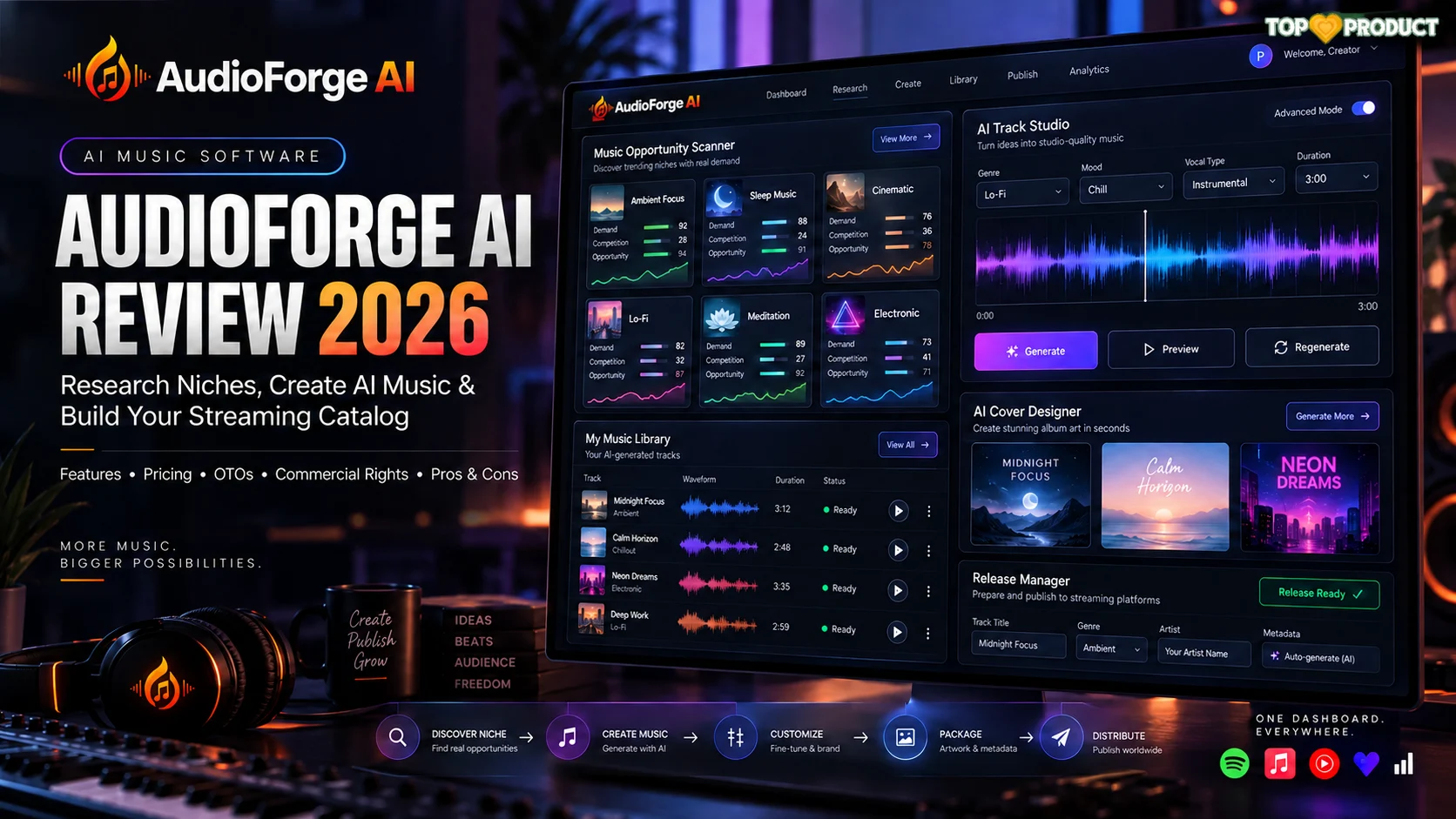
AudioForge AI is a cloud-based AI music platform from Peter Onwe that is being marketed as a way to research music niches, generate original tracks, prepare metadata and artwork, and distribute music to streaming platforms from one workflow.
The product is scheduled to launch through Launchpad on September 12, 2026, with a listed front-end price of $17 and a 50% affiliate commission. The public MunchEye listing confirms the vendor, date, price, marketplace, and software category.
What interests me isn’t the “passive-income” language on the promotion page. It’s whether AudioForge AI provides enough useful functionality to justify buying the software—and what you need to understand before relying on it for Spotify or other streaming platforms.
This review is based on the official JV documentation, public launch information, Launchpad policies, and current distribution/streaming rules. I have not personally logged into or tested the AudioForge AI dashboard, so I will not pretend otherwise.
Research updated: September 12, 2026.
Affiliate disclosure: This review may contain affiliate links. If you purchase through one of those links, I may earn a commission at no additional cost to you. This does not affect my evaluation of the product.
Quick Verdict
| Item | Verdict |
|---|---|
| Product | AudioForge AI |
| Creator | Peter Onwe |
| Marketplace | Launchpad |
| Category | AI music creation / publishing software |
| Front-End Price | $17 at launch |
| Coupon | No independently verified coupon at time of research |
| Guarantee | Launchpad currently publishes a 30-day software refund policy |
| Best For | Creators and marketers who want an integrated AI-music workflow |
| Not Ideal For | Anyone expecting guaranteed passive streaming income |
| Overall Rating | 7/10 — Provisional |
| Verdict | Recommended With Conditions |
My Quick Take
At $17, AudioForge AI looks interesting because the vendor is positioning it as much more than an AI song generator. The intended workflow combines niche research, track creation, metadata, cover design and distribution preparation.
The concern is that several of the strongest marketing claims—especially around “profitable” niches, automatic royalties and long-term passive income—have not been independently demonstrated. Current Spotify rules also make the idea that every generated track automatically earns money far too simplistic.

AudioForge AI Review — Product Overview
| Item | Details |
|---|---|
| Product | AudioForge AI |
| Creator | Peter Onwe |
| Marketplace | Launchpad |
| Category | Cloud-based AI music software |
| Launch Date | September 12, 2026 |
| Advertised Launch Time | 11:00 AM EDT on MunchEye |
| Front-End Price | $17 |
| Commission | 50% affiliate commission |
| Coupon | None independently verified |
| Guarantee | Launchpad general software policy currently states 30 days |
| Commercial License | Included according to vendor documentation |
| Beginner Friendly | Vendor says no musical experience is required; not hands-on verified |
| Upgrades | Order bump + 11 published OTOs |
| Support | Launchpad handles payment/refund/delivery issues; product-specific support may involve vendor |
| Overall Verdict | Recommended With Conditions |
| Official Landing Page / Sales Page | Official AudioForge AI sales page |
The launch information above is supported by the current public listing and official JV material.
What Is AudioForge AI?
In plain English, AudioForge AI is supposed to help you go from “What kind of music should I create?” to a prepared music catalog without juggling as many separate tools.
According to the official JV documentation, the platform is designed to:
- Scan Spotify and other music-market data for lower-competition micro-genres.
- Generate AI-created tracks within a selected niche.
- Produce titles, genre information and promotional metadata.
- Generate cover artwork.
- Prepare or publish releases across numerous streaming platforms.
- Track music projects through a central dashboard.
The vendor describes this as a highly automated workflow and says users do not need traditional musical skills. Those are vendor claims rather than conclusions from my own testing.
That distinction matters.
Generating a track is one problem. Creating music people genuinely choose to listen to—and obtaining legitimate streams—is a very different problem.

What Problem Is AudioForge AI Trying to Solve?
The traditional workflow for launching AI-assisted music can become fragmented quickly.
You might need one tool for niche research, another for music generation, another for artwork, spreadsheets for metadata, and then a distributor for Spotify, Apple Music and other services.
You also need to decide:
- what music to make,
- which audience might want it,
- how to name and package it,
- where to distribute it,
- and how to promote it after release.
AudioForge AI attempts to bring much of that process into one interface.
That is probably the product’s strongest idea.
Instead of starting with “generate a random song,” the workflow supposedly starts with market opportunity, then moves into creation and publishing.
Whether its opportunity scoring accurately predicts commercial demand is another matter. I found no independent validation demonstrating that the scanner can reliably identify profitable genres.
How Does AudioForge AI Work?
Based on the official workflow, the process appears to work roughly like this:
Step 1 — Find a Music Opportunity
You choose a keyword or niche.
AudioForge AI reportedly scans streaming data to identify micro-genres with comparatively favorable competition and demand.
Its Opportunity Score Reports are marketed as showing factors such as ease of entry, estimated revenue and playlist-placement timing. These predictive metrics should be treated as estimates rather than guaranteed outcomes.
Step 2 — Generate Your Tracks
The vendor says the system can generate between 5 and 25 tracks in a run, including instrumentals, lyrics and AI vocals depending on the project.
You can preview the output and regenerate material.
Step 3 — Prepare the Release
AudioForge AI reportedly creates:
- track titles,
- artist information,
- genre tags,
- playlist descriptions,
- cover artwork,
- and release metadata.
An ISRC/copyright assistant is also advertised.
However, I could not verify exactly how ISRC issuance works inside AudioForge AI. Distributors such as DistroKid normally generate ISRCs for releases themselves.
Step 4 — Publish or Export
The vendor advertises publishing support across 200+ platforms.
I could not independently verify the complete platform list or determine whether third-party distributor accounts, subscription costs or external APIs are required.
Step 5 — Build an Audience
This is the part no AI button can eliminate.
Your music still needs legitimate listeners.
Spotify specifically warns against artificial-streaming services and says artificial streams do not earn royalties.

Key AudioForge AI Features
1. Spotify Market Scanner
What it does:
The vendor says it analyzes Spotify markets for potentially underserved micro-genres.
Why it matters:
Starting with demand is more rational than creating random tracks and hoping somebody listens.
Best use case:
Finding narrower concepts such as sleep, focus, ambient or mood-based niches to investigate further.
Potential limitation:
There is no independent evidence yet showing how accurate its opportunity predictions are.
2. Opportunity Score Reports
The software reportedly analyzes factors including competition, potential revenue and placement opportunities.
This could be useful for prioritization.
But predicted revenue should never be confused with actual revenue. Streaming results depend on real listener demand, promotional reach, platform eligibility and retention.
3. AI Music Generation
AudioForge AI advertises original beats, instrumentals, lyrics and AI vocals.
The major benefit is obvious: someone without traditional production skills could potentially create usable starting material.
The limitation is equally important: AI-generated does not automatically mean copyright-protected.
The U.S. Copyright Office has stated that copyright protection depends on sufficient human authorship; prompting by itself does not necessarily satisfy that threshold.
A commercial license from AudioForge AI may give you contractual permission to monetize an output, but that is not identical to guaranteed copyright protection.
4. Multi-Track Creation
The vendor says users can create 5–25 tracks per run.
That’s attractive if you’re building a themed catalog.
But quantity needs to be handled carefully.
DistroKid permits AI-generated music subject to rights and content rules, while explicitly prohibiting mass-generated spam intended to manipulate streaming systems.
Use catalog generation to create genuinely useful music—not to flood platforms.
5. Live Preview and Regeneration
Being able to preview and regenerate a track before publishing could reduce wasted releases.
For beginners, this is potentially one of the more practical features because AI output often needs multiple iterations.
6. AI Cover Art Designer
Artwork generation removes another separate step from the release workflow.
That may save time, particularly when producing multiple releases.
You should still review every image for quality, misleading elements, trademarks and unwanted visual artifacts before publication.
7. Metadata and Title Generation
The platform reportedly prepares titles, descriptions and genre information.
This feature isn’t exciting, but operationally it may be one of the biggest time savers.
Good organization becomes increasingly important when managing dozens of tracks.
8. 200+ Platform Auto-Publisher
This is one of the most ambitious vendor claims.
If AudioForge AI genuinely connects creation, metadata and distribution efficiently, it could substantially reduce workflow friction.
However, I would verify exactly what “auto-publisher” means at checkout—particularly whether external distributor accounts or additional charges are involved.
9. Commercial Rights
The vendor states that buyers receive a full commercial license for generated tracks.
That is important for people planning to monetize their output.
Again, commercial usage rights should not be confused with automatic copyright registration or guaranteed copyrightability.
What I Like About AudioForge AI
1. The workflow starts with research
The product attempts to answer “what should I make?” before generating content.
That’s a better business-oriented approach than blindly producing AI music.
2. It brings multiple tasks together
Research, music generation, metadata, cover design and publishing preparation in one workflow could reduce tool switching.
3. The $17 front-end price is accessible
For someone experimenting with AI music, $17 is a relatively low entry price.
4. Commercial usage is part of the core positioning
The vendor says commercial rights are included rather than reserving them entirely for an expensive professional tier.
5. Regeneration makes sense for AI output
Human review remains necessary. Easy regeneration makes that less painful.
What Could Be Better?
This is where buyers should pay attention.
1. The passive-income language is too aggressive
The JV material uses phrases suggesting tracks can become long-term automated royalty assets.
That is a marketing interpretation—not a guaranteed business outcome.
Spotify currently requires a track to reach at least 1,000 streams during the previous 12 months, along with a minimum number of unique listeners, before it can enter Spotify’s recorded-music royalty pool.
So the idea that simply uploading AI music means “every stream makes money forever” is not accurate as a universal statement.
2. Important operating costs are unclear
I could not independently verify:
- external API requirements,
- distributor requirements,
- third-party subscription costs,
- exact front-end generation limits,
- storage limits,
- or publishing quotas.
The existence of an Unlimited Version OTO strongly suggests that the front end has some usage limits, but the precise caps were not clear in the accessible documentation.
3. There is little independent evidence yet
This is a launch-day product.
There is not enough mature third-party user history for me to say how reliably the software performs over months of real use.
4. AI distribution policies matter
TuneCore, for example, says AI-generated releases are accepted when the generative model relies on properly licensed training datasets and encourages artists to investigate the model’s training-data policies.
I could not verify what underlying generation model AudioForge AI uses or its training-data provenance.
5. The funnel is extensive
The $17 front end is only the beginning if you want everything.
There is an order bump plus 11 published upsells.
AudioForge AI Pros and Cons
| Pros | Cons |
|---|---|
| Low $17 launch entry price | 11 OTOs plus an order bump |
| Combines several music workflow steps | No hands-on independent validation yet |
| Market-research-first concept | Opportunity/profit estimates are vendor claims |
| AI music + metadata + cover workflow | Exact front-end limits unclear |
| Commercial license advertised | External/API/distribution costs not confirmed |
| Multi-track generation | Platform rules can restrict AI/spam-style releases |
| Beginner-oriented positioning | Passive-income language is overly optimistic |
Who Should Use AudioForge AI?
AI Content Creators
Useful if you want to experiment with music without assembling a traditional recording setup.
Internet Marketers
The research-first approach may appeal to marketers who naturally think in terms of niches, demand and competition.
YouTubers and Digital Creators
Music could potentially support your own content—subject to the commercial rights and platform rules.
Freelancers
If output quality is sufficient, the commercial license could potentially support services such as custom music creation for clients.
Experimental Music Entrepreneurs
If you understand that distribution is a real business requiring promotion and quality control, the tool may reduce production friction.
Who Should NOT Buy AudioForge AI?
Skip it if:
- you believe $17 will automatically produce passive income;
- you expect guaranteed Spotify streams;
- you plan to mass-upload low-quality tracks to manipulate algorithms;
- you require independently proven revenue data before buying;
- you need advanced DAW-level production control;
- you require fully documented AI training-data provenance before distributing commercially;
- or you cannot tolerate additional upsells.
You should also wait if your buying decision depends on knowing the exact API, distribution or front-end usage limits. Those details were not independently clear enough for me to guarantee them.
Realistic Ways to Use AudioForge AI
Rather than thinking “push button → royalties,” consider these more realistic models.
1. Build a Small Themed Music Catalog
Research a narrow audience, produce a limited catalog, test listener response, then expand only if demand appears.
2. Create Music for Your Own Content
Generate background material for videos, podcasts or other projects where the license permits it.
3. Offer Custom Music Services
A freelancer could potentially package AI-assisted music creation as a client service.
The value would come from research, customization, editing, communication and delivery—not merely pressing “generate.”
4. Develop Tracks for Legitimate Streaming Distribution
Create quality music, review it, distribute it properly and market it to genuine listeners.
5. Test Multiple Niches Efficiently
The research and rapid-production workflow could reduce the cost of experimenting before committing heavily to one style.
Can You Make Money With AudioForge AI?
Potentially—but AudioForge AI itself does not create guaranteed income.
Streaming revenue depends on factors including:
- music quality,
- listener demand,
- legitimate traffic,
- niche selection,
- promotion,
- playlist discovery,
- platform eligibility,
- distribution agreements,
- geographic listener mix,
- consistency,
- and competition.
Spotify explicitly says artificial streams do not generate royalties and warns against services guaranteeing streams or playlist placements.
The right mental model is:
AudioForge AI may help create and organize the asset. It does not automatically create the audience.
AudioForge AI Pricing
The public launch listing gives the front-end price as:
Front End: $17
That is confirmed in the current launch information.
The bigger question is what happens after the initial checkout.
AudioForge AI Coupon / Discount
I did not independently verify an active public AudioForge AI coupon code during this research.
Do not trust a review claiming a special coupon unless you can confirm that code at checkout.
AudioForge AI Bonuses
Vendor Bonuses
I did not find enough independently confirmed information to responsibly list specific vendor bonuses as guaranteed inclusions.
Check the live checkout/sales page for the current bundle.
My Exclusive Affiliate Bonuses
No exclusive affiliate bonus package was supplied for this review.
I would not invent “$10,000 bonus packages” simply to make the offer appear more valuable.
If you later create a genuine bonus package for buyers using your affiliate link, add it here with clear descriptions of what each bonus actually includes.
Refund Policy / Guarantee
Launchpad’s current general refund policy for digital software licenses states that customers can request a full refund within 30 days, and describes the policy as no-questions-asked. Refund requests require the order number and account email, and refunded software access is disabled.
Launchpad says refund requests can be sent to its refund support channel and that it aims to process requests within 48 hours.
Because policies can change, verify the exact terms shown during checkout before purchasing.
Is AudioForge AI Legit or a Scam?
I found no evidence that AudioForge AI itself is a scam.
There are several reasons:
- Peter Onwe is publicly identified as the vendor.
- AudioForge AI has a documented Launchpad launch.
- The vendor has a visible history of previous software launches.
- There is a detailed official JV page.
- Launchpad publishes a software refund policy.
MunchEye’s vendor history shows multiple previous 2026 launches from Peter Onwe, including Book Flipper AI, EstyEmpire AI, RoyaltyMiner AI and several other software products.
However, “legitimate product launch” does not mean every promotional statement is proven.
I would specifically treat revenue estimates, passive-income projections, EPC/conversion claims and statements implying permanent automatic royalties as marketing claims unless independent evidence becomes available.
So my verdict is:
Legitimate-looking software offer, but buy it for the workflow—not because of income promises.
AudioForge AI vs Alternatives
| Factor | AudioForge AI | Suno | SOUNDRAW |
|---|---|---|---|
| Main Strength | Research + generation + publishing workflow | Strong AI song generation | AI music with more explicit licensing positioning |
| Entry Price | $17 launch FE | Free plan; paid plans available | Paid subscription plans |
| Commercial Rights | Vendor says included | Available for songs created under qualifying paid subscription | Depends on plan/license conditions |
| Niche Research | Built into vendor’s pitch | Not its main purpose | Not its main purpose |
| Distribution | Vendor claims 200+ platform publishing workflow | Separate distributor generally required | Separate distributor generally required |
| Recurring Cost | Core offer marketed at $17; external costs unclear | Subscription for paid commercial features | Subscription |
| Best For | Marketers wanting an integrated workflow | Users focused mainly on AI song generation | Creators emphasizing music-generation licensing transparency |
Suno currently publishes free and paid tiers and says songs created while appropriately subscribed can receive commercial-use rights, although commercial permission still does not guarantee copyright protection.
SOUNDRAW publishes creator/artist subscription plans and allows DSP distribution under its licensing rules, though some distribution rights require modification of the generated beat rather than simply uploading it unchanged.
Which Should You Choose?
Choose AudioForge AI if the integrated research → creation → metadata → distribution concept is more important to you than having a long product track record.
Choose Suno if your primary requirement is straightforward AI song generation from a more established specialist platform.
Consider SOUNDRAW if its licensing approach and production workflow fit your use case better.
There is no reason to automatically declare AudioForge AI the winner for everyone.
Is AudioForge AI Worth It?
Worth considering if…
- You specifically want to experiment with AI music.
- You value market research as much as song generation.
- You like the idea of keeping research, creation, artwork and metadata together.
- You’re comfortable manually reviewing AI output.
- You understand that audience building is still your responsibility.
- The $17 front-end package includes enough capacity for your intended use.
Skip it if…
- You’re buying primarily because of passive-income promises.
- You expect the software to generate listeners automatically.
- You need proven user results before purchasing.
- You require fully documented external costs and AI-model provenance.
- You only need AI music generation and already subscribe to a capable alternative.
My Verdict
AudioForge AI is worth considering at the $17 front-end price, but with conditions.
The integrated workflow is the strongest reason to buy. The platform is trying to solve more of the music-business process than a basic text-to-music generator.
The biggest limitation is uncertainty: this is a new launch, I have not personally tested the dashboard, several operational details remain unclear, and the promotional material makes aggressive claims about streaming income.
My provisional rating is 7/10.
Buy it because you want the workflow—not because you expect automated royalties.
Frequently Asked Questions
What is AudioForge AI?
AudioForge AI is cloud-based software marketed for researching music niches, generating AI music, producing metadata and cover artwork, and preparing/distributing releases.
Who created AudioForge AI?
The product is launched by Peter Onwe through Launchpad.
How much does AudioForge AI cost?
The advertised launch front-end price is $17. Optional upgrades cost extra.
Is AudioForge AI beginner friendly?
The vendor says no musical experience is required. I have not independently tested the interface, so I cannot confirm the actual learning curve.
Does AudioForge AI have monthly fees?
I could not independently verify whether external services, APIs or distribution accounts may create recurring costs. Verify this before checkout if it affects your decision.
Does AudioForge AI require API keys?
That was not clearly confirmed in the documentation I could verify.
Does AudioForge AI have OTOs?
Yes. The published funnel currently includes a $17 order bump and 11 OTOs.
Is there an AudioForge AI coupon?
I did not independently verify an active coupon at research time.
Does AudioForge AI include commercial rights?
The official promotional documentation says a full commercial license is included. That is a vendor-stated license benefit, not a guarantee that every AI output receives statutory copyright protection.
Is AudioForge AI legit?
I found evidence of an identifiable vendor, documented Launchpad launch and official product funnel. I found no evidence that the product itself is a scam, although income claims should not be interpreted as guaranteed results.
Does AudioForge AI have a refund guarantee?
Launchpad’s current general digital-software refund policy provides a 30-day refund window. Confirm the terms presented at checkout because policies can change.
Final Verdict — AudioForge AI Review
The real problem AudioForge AI tries to solve isn’t simply “how do I generate an AI song?”
It’s the much longer process of deciding what to create, creating it efficiently, packaging it correctly and getting it ready for distribution.
That integrated concept is what makes AudioForge AI interesting.
The $17 entry price also makes experimentation relatively inexpensive.
But I would ignore the idea that creating a large AI music catalog automatically results in permanent passive income. Spotify has clear eligibility and artificial-streaming rules, distributors maintain their own AI-content policies, and successful music still needs genuine listeners.
If you’re an AI creator, marketer or entrepreneur who understands those limitations and wants a faster research-to-release workflow, AudioForge AI is worth considering at its front-end price.
If you’re looking for guaranteed royalties, effortless Spotify traffic or a push-button income machine, skip it.
Final verdict: Recommended With Conditions — 7/10 provisional.