If you have seen Own AI Hub promoted as a way to launch your own branded AI subscription business, there is one question worth answering before anything else:
Are you buying useful software—or simply buying an attractive business-opportunity promise?
Own AI Hub is a new software launch from Justin Opay that is being marketed as a shortcut for building a customer-facing AI platform without developing the underlying technology yourself. Public launch calendars confirm the September 11, 2026 Launchpad launch and a $17 front-end price.
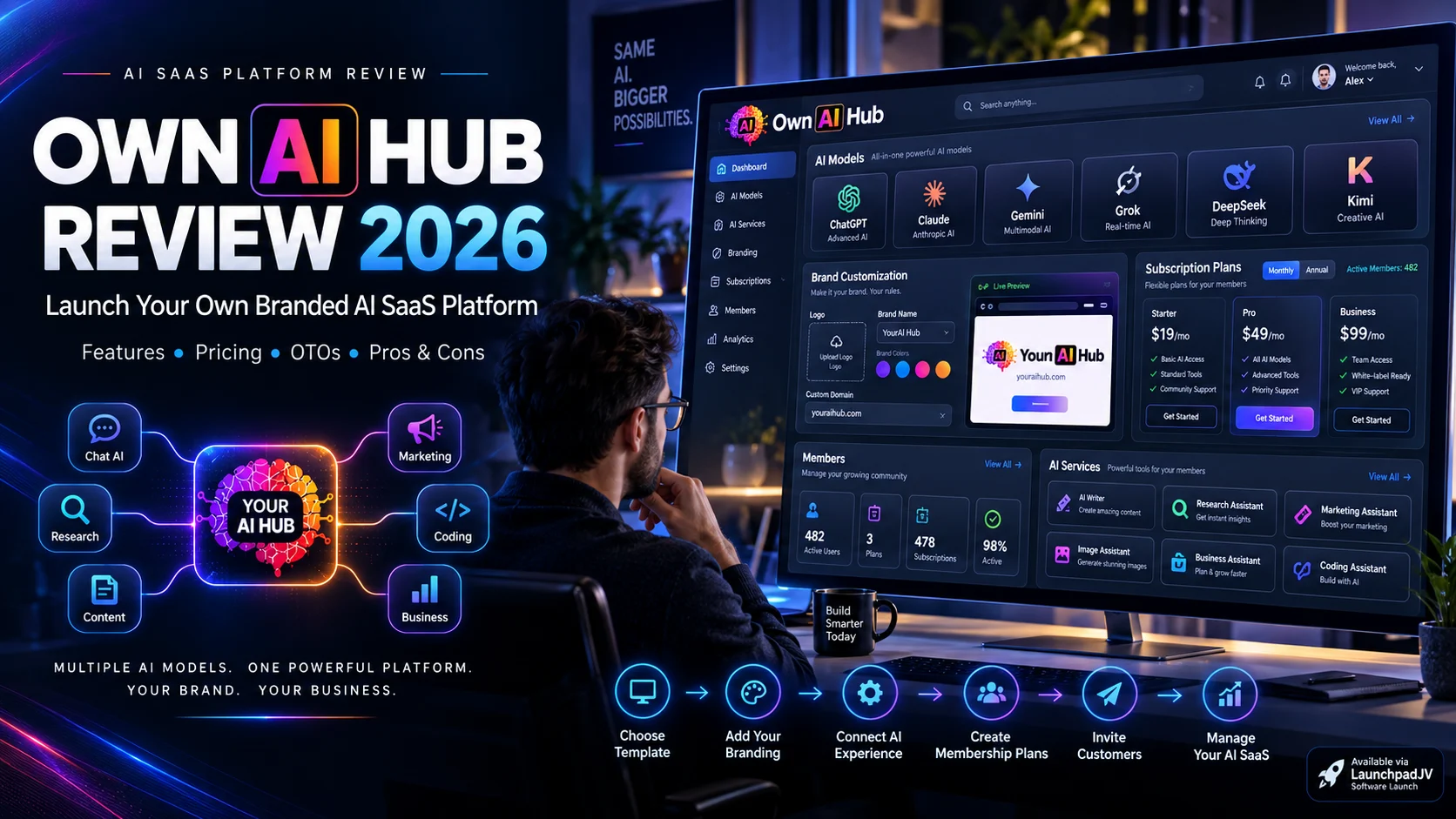
The promotional proposition goes further. Current indexed launch coverage describes a system where you choose a template, add your own branding, configure subscription plans and provide customers with access to multiple AI models.
That is an interesting idea—but there are several details you need to understand before buying.
In this Own AI Hub review, I will separate what I could verify from what is currently promotional material, examine the business model, discuss the limitations and compare it with established alternatives.
Affiliate Disclosure
This review contains affiliate links. If you purchase through one of my links, I may earn a commission at no additional cost to you. This does not affect my evaluation of the product.
I was not supplied with verified first-hand dashboard testing or personal usage results, so I will not claim that I personally tested Own AI Hub.
Quick Verdict
| Item | Details |
|---|---|
| Product | Own AI Hub |
| Creator | Justin Opay |
| Marketplace / Network | Launchpad |
| Category | White-label / branded multi-model AI SaaS platform |
| Launch Date | September 11, 2026 |
| Front-End Price | $17 at time checked |
| Coupon | No current coupon independently verified |
| Guarantee | Terms not independently verified |
| Best For | Entrepreneurs, freelancers and agencies specifically wanting to experiment with a branded AI-subscription offer |
| Not Ideal For | People expecting automated income or buyers who simply need an AI chatbot for personal use |
| Overall Rating | 7.4/10 |
| Verdict | Recommended With Conditions |
Quick Verdict Summary
The concept behind Own AI Hub is stronger than the typical “another AI writer” launch because it is aimed at helping users create a branded subscription product rather than merely consume AI.
The $17 front-end price is also unusually low for this type of proposition.
My main reservation is evidence. This is a brand-new launch, I have not independently tested the dashboard, and several important commercial details—including exact usage limits, guarantee conditions, model-access arrangements and upgrade pricing—remain unverified.

Own AI Hub Review — Product Overview
| Item | Details |
|---|---|
| Product | Own AI Hub |
| Creator | Justin Opay |
| Marketplace | Launchpad |
| Category | AI SaaS / branded multi-model AI platform |
| Launch Date | September 11, 2026 |
| Front-End Price | $17 when checked September 11, 2026 |
| Coupon | Not independently verified |
| Guarantee | Not independently verified |
| Commercial License | Promoted as included; exact legal terms should be checked before selling access |
| Beginner Friendly | Marketed as no-code |
| Upgrades | Funnel exists or may change during launch; exact current upgrade pricing not independently verified |
| Support | Product-specific support details not independently verified |
| Overall Verdict | Recommended with conditions |
| Official Landing Page / Sales Page | Official Own AI Hub Sales Page |
What Is Own AI Hub?
Own AI Hub is being marketed as a platform for creating your own branded AI website or subscription service.
Instead of sending customers to multiple individual AI services, the idea is to give them access through a platform carrying your own name, logo, colors and potentially your own domain.
Current indexed promotional coverage describes support for AI brands/models including ChatGPT, Claude, Gemini, Grok, DeepSeek and Kimi. It also describes templates, subscription billing, member management, custom domains, hosting, SSL and a commercial license. These remain vendor-promoted capabilities rather than independently tested findings.
That distinction matters.
Own AI Hub is not being positioned simply as another writing assistant. The main proposition is closer to:
AI access + membership software + branding + monetization infrastructure.
The buyer is effectively being offered the foundation for an AI subscription business.
What Problem Is Own AI Hub Trying to Solve?
Building even a basic SaaS product normally creates several separate jobs.
You need a website. You may need authentication, user accounts, AI-provider integrations, hosting, payment handling, branding and customer management.
Then you need to maintain everything.
Own AI Hub attempts to remove much of that setup friction.
The promotional material describes a process without coding, manual API configuration or your own hosting setup.
For the right buyer, that is the real attraction.
But there is an important distinction between launching the software and building the business.
Own AI Hub may reduce technical friction. It cannot automatically answer:
- Who should subscribe?
- Why should they choose your service instead of ChatGPT, Claude, Gemini, Poe or dozens of other platforms?
- What will you charge?
- How will you acquire customers?
- What support will you provide?
- Why will customers renew next month?
Those are business problems, not software-installation problems.
How Does Own AI Hub Work?
Based on the currently indexed promotional documentation, the process appears intentionally simple.
Step 1 — Access the Platform
You log into the web application.
The vendor’s promotional material says the intended setup avoids traditional software installation and manual AI API configuration.
Step 2 — Choose and Customize Your Platform
Select a template and add branding such as your:
- business/platform name
- logo
- colors
- copy
- pricing
Step 3 — Create Your Subscription Offer
The marketing material says users can create different customer plans.
That theoretically allows you to build tiers—for example, a basic membership and a more expensive premium plan.
Step 4 — Add Customers
Members join the platform and access the AI functionality included in their account.
Step 5 — Operate the Business
This is the part that no “three-click” sales pitch should gloss over.
You still need to attract customers, answer questions, improve the offer, reduce cancellations and ensure that your pricing makes economic sense.
Not automated: niche selection, positioning, lead generation, customer trust, retention strategy and most of the work involved in building a durable business.

Key Own AI Hub Features
1. Branded AI Platform
What it does: Promotional materials say you can customize the AI portal with your branding.
Why it matters: Customers interact with your business identity rather than a collection of unrelated AI websites.
Best use case: An agency building a niche AI workspace for its client base.
Potential limitation: I have not independently verified the depth of customization. “Branding” could mean anything from changing a logo to extensive white-label customization, so check the live demonstration.

2. Multiple AI Models
What it does: Current marketing material promotes access to several major AI providers/models through one environment.
Why it matters: Different models can be better suited to different workloads.
Best use case: Providing customers with a single interface rather than asking them to manage several separate tools.
Potential limitation: Exact model versions, quotas, rate limits and future availability were not independently verified.
3. Subscription Billing
What it does: The product is promoted around charging members recurring fees.
Why it matters: That changes the business model from one-off client work to potential recurring revenue.
Best use case: A specialist service offering AI tools to a defined audience.
Potential limitation: Recurring billing does not mean recurring profit. Customers must continue seeing enough value to remain subscribed.
4. Member Management
Marketing descriptions say owners can manage members, plans, payments and renewals from a central dashboard.
That could remove the need to assemble a separate membership stack.
The exact administrative controls should still be confirmed in the product demonstration.
5. Custom Domain Support
A custom domain is promoted as part of the system.
That is useful because a customer-facing SaaS product generally looks more credible on the owner’s domain than on a generic shared subdomain.
6. Hosting and SSL
Promotional material says hosting and SSL are included.
If accurate, this removes another technical and recurring-cost consideration.
However, I would specifically verify fair-use limits, traffic limits and any conditions applied to customer/member volume before building a large business around that promise.
7. No Manual API Setup
The launch material says buyers do not need to provide or configure individual AI API keys for the advertised setup.
This could be a major beginner-friendly benefit.
It is also one of the claims I would investigate most carefully before purchase because AI inference has a real operating cost somewhere in the system.
Understand exactly what usage is included and what happens when customer activity grows.
8. Commercial Usage
The product is promoted with a commercial license allowing users to sell access to customers.
This is central to the entire value proposition.
But commercial rights are not automatically the same as unrestricted reseller, source-code or white-label ownership rights.
Read the actual license supplied at checkout before promising clients rights that exceed what the vendor grants you.
What I Like About Own AI Hub
The first positive is the business model focus.
Many low-ticket AI launches give you another content generator. Own AI Hub is attempting to give buyers infrastructure they can potentially package into their own offer.
Second, the publicly listed $17 front-end price creates a fairly low entry barrier.
Third, consolidating branding, customer management and AI access can be easier than stitching those pieces together manually.
Fourth, the creator is identifiable. Justin Opay maintains a public business site describing work in funnels, automation and digital-product launches, and MunchEye lists multiple launches associated with his name. His site also makes several performance and client-count claims; those should be treated as self-reported marketing claims rather than independent proof.
Finally, the product is aimed at a real market need. Multi-model interfaces already have established alternatives, demonstrating that users do value centralized access to multiple AI providers. TypingMind, for example, currently promotes support for 22+ AI providers and multi-model conversations.
What Could Be Better?
The biggest weakness is simply lack of independent evidence.
This is a launch-day product. I did not find meaningful independent customer discussion specifically about Own AI Hub on Reddit during this research.
Second, several promotional claims deserve technical clarification—particularly included AI usage.
AI models cost money to operate. If the front-end purchase is $17 and the product claims to eliminate customers’ need for their own APIs, buyers should understand exactly how inference is funded, what limits exist and whether conditions change at higher usage levels.
Third, business-opportunity language can make the process sound easier than it is.
Setting up an AI portal is not the same thing as finding paying subscribers.

Fourth, the current OTO funnel is insufficiently verified. Buyers searching “Own AI Hub OTO” generally want to know the true total cost before entering a sales funnel. I could not independently confirm current upgrade names and prices, so I will not invent them.
Finally, the refund/guarantee terms need to be checked directly at checkout. A guarantee should not be assumed simply because similar launches use one.
Own AI Hub Pros and Cons
| Pros | Cons |
|---|---|
| $17 publicly listed launch price | Very new product with little independent customer evidence |
| Interesting SaaS/subscription angle | Exact AI usage limits need clarification |
| Marketed as no-code | Dashboard not independently tested for this review |
| Branded customer-facing platform | Customer acquisition remains your responsibility |
| Multi-model concept | Exact model/version availability can change |
| Commercial-use proposition | License details should be read carefully |
| Hosting/SSL promoted as included | OTO pricing not independently verified |
| Potentially beginner-friendly | Guarantee and coupon currently unverified |
Who Should Use Own AI Hub?
Freelancers could use a branded AI workspace as an additional service instead of relying only on hourly work.
Agencies may find the concept useful if they want to create a niche AI membership for existing clients.
Affiliate marketers interested in building their own asset rather than continually promoting someone else’s offer may find the SaaS angle appealing.
Consultants and coaches could potentially package AI access with niche-specific prompts, resources, training and support.
SaaS beginners who are comfortable marketing a product but do not want to build software infrastructure from scratch are probably the closest match to the intended buyer.

Who Should NOT Buy Own AI Hub?
Skip it if you expect a $17 purchase to produce automatic recurring income.
Do not buy it solely because screenshots show potential subscription prices.
You should also probably skip it if:
- you only need AI for yourself;
- you do not want to market to customers;
- you do not want to provide customer support;
- you need enterprise-grade compliance that has not been documented;
- you need specific guaranteed model limits;
- you already operate a more advanced AI platform;
- you are uncomfortable buying until the full OTO and usage-cost structure is clear.
Realistic Ways to Use Own AI Hub
A more realistic strategy is to build around a specific audience, rather than trying to compete with ChatGPT as a generic AI service.
Examples could include:
- An AI workspace for real-estate agents.
- A marketing AI portal for local businesses.
- An AI toolkit packaged into an existing consulting service.
- A member benefit for a paid marketing community.
- A niche AI portal for freelancers or creators.
- A client-facing agency add-on.
The software itself is only the infrastructure.
Your differentiation comes from your niche, positioning, resources, onboarding, workflows and customer support.
Can You Make Money With Own AI Hub?
Possibly—but the software cannot guarantee that.
The revenue model is straightforward:
Acquire customer → customer subscribes → deliver ongoing value → retain customer.
Profit depends on factors such as customer-acquisition cost, subscription price, churn, included usage costs, support overhead and competition.

Do not treat screenshots showing potential $9, $19, $47 or other membership pricing as proof that people will pay those amounts.
The difficult part is not creating a pricing button.
The difficult part is creating a reason for someone to continue paying.
Own AI Hub Pricing
The strongest independently verifiable pricing information I found is the $17 front-end price listed on MunchEye for the September 11, 2026 Launchpad launch.
Front End: $17
At the promotional level, this reportedly includes the core platform and commercial-use proposition.
However, I recommend checking four things at checkout:
- Member or usage limits.
- AI-model limits.
- Third-party/payment-processing costs.
- Upgrade restrictions.
The launch material is also described as having no monthly hosting/API fee for the advertised core setup, but I have not independently verified the contractual terms behind that statement.
Own AI Hub OTOs / Upsells
I could not independently verify the complete current Own AI Hub upgrade funnel.
| Offer | Price | What It Adds | Verdict |
|---|---|---|---|
| Front End | $17 | Core Own AI Hub offer | Confirmed launch-calendar price |
| Post-purchase upgrades | Not verified | Current funnel details unavailable | Evaluate individually |
| Additional licenses / higher limits | Not verified | Do not assume they are included | Check checkout |
Current upgrade pricing was not independently verified and may change during the launch.
This is better than publishing guessed OTO names copied from another affiliate page.
Own AI Hub Coupon / Discount
Verified coupon: OWNAI3OFF
30% OFF OWN AI HUB
Own AI Hub Bonuses
Vendor Bonuses
No specific vendor bonus package was independently confirmed strongly enough for me to reproduce as fact.
My Exclusive Affiliate Bonuses
No exclusive affiliate bonus package or bonus URL was supplied for this review.
Therefore, none has been invented.
If bonuses are later added, list exactly what buyers receive and avoid meaningless inflated “$10,000 value” claims.
Refund Policy / Guarantee
I was unable to independently verify Own AI Hub’s current refund period and conditions.
Before publishing a fixed number of days, verify the policy at the live checkout or through official Launchpad documentation.
Until then, the responsible description is:
Guarantee terms: confirm on the current checkout page before purchase.
Is Own AI Hub Legit or a Scam?
I found no evidence establishing that Own AI Hub itself is a scam.
The vendor is identifiable, maintains a public business website, and Own AI Hub appears on multiple public affiliate-launch calendars as a September 11 Launchpad software launch.
That is evidence that this is a real commercial launch.
It is not evidence that every promotional claim will deliver exactly the results a buyer imagines.
Because the product is extremely new and independent customer evidence is limited, I would describe Own AI Hub as legitimate-looking but not yet independently proven over time.
Anyone presenting guaranteed recurring income, guaranteed traffic or effortless profits should be treated with caution.
Own AI Hub vs Alternatives
| Factor | Own AI Hub | TypingMind | Open WebUI |
|---|---|---|---|
| Main Goal | Branded AI subscription business | Multi-model AI frontend | Self-hosted AI interface |
| Entry Price | $17 launch FE | $39 Standard, $79 Extended, $99 Premium currently | Core use can be free with licensing conditions |
| AI Costs | Vendor promotes no manual API requirement; exact limits unverified | API usage paid separately | Depends on models/providers used |
| White-Label Focus | Core promotional angle | Custom/team option separate from normal personal license | Larger white-label deployments require appropriate licensing |
| Ease of Setup | Promoted as beginner/no-code | Straightforward hosted frontend | More technical when self-hosting |
| Best For | Building a branded customer offer | Personal/professional multi-model AI use | Technical users and organizations wanting infrastructure control |
There is also Poe, which offers centralized access to many AI models through a conventional subscription model. Its official pricing page currently uses compute-point plans with recurring subscriptions.
The important difference is intent.
If you simply want access to multiple AI models yourself, an established service like TypingMind, Poe or Open WebUI may make more sense.
If you specifically want a customer-facing branded subscription business, Own AI Hub is targeting a different use case.
Is Own AI Hub Worth It?
Worth considering if:
You want to experiment with launching a branded AI service, understand that you still need to acquire customers, and the $17 front-end contains enough core functionality for your intended model.
Skip it if:
You are buying primarily because you expect automatic monthly income or because an earnings example made the opportunity look effortless.
At $17, the front-end does not need to replace an enterprise SaaS stack to represent reasonable value.
But the real buying decision should depend on something more important:
Does the front end give you the usage limits, commercial rights and model access you actually need without forcing you into upgrades?
Confirm those details before purchasing.
Frequently Asked Questions
What is Own AI Hub?
It is a newly launched software product promoted as a way to create a branded, customer-facing AI subscription platform.
Who created Own AI Hub?
Public launch sources identify Justin Opay as the vendor.
How much does Own AI Hub cost?
MunchEye lists a $17 front-end price for the September 11, 2026 Launchpad launch.
Is Own AI Hub beginner friendly?
The promotional material describes a no-code workflow without manual API or hosting setup. This was not independently tested for this review.
Does Own AI Hub have monthly fees?
Promotional material says the core setup avoids recurring hosting/API charges, but exact usage and contractual limits should be verified before buying.
Does Own AI Hub require API keys?
The current vendor-promoted setup says users do not need to configure individual API keys themselves.
Are there Own AI Hub OTOs?
Post-purchase upgrades may be offered, but I could not independently verify the current complete funnel and prices. I therefore have not published guessed OTO information.
Is there an Own AI Hub coupon?
No current coupon was independently verified during this research.
Does Own AI Hub include commercial rights?
Commercial usage is promoted as part of the offer, although the exact license should be read before selling subscriptions or services.
Is Own AI Hub legit?
It appears to be a genuine Launchpad software launch from an identifiable vendor. That should not be confused with independent proof of every promotional claim.
Where can I buy Own AI Hub?
Use the current official offer through the affiliate link associated with this review.
Final Verdict — Own AI Hub Review
The most interesting thing about Own AI Hub is not access to another AI model.
It is the attempt to transform AI access into something you can package under your own business identity.
For freelancers, agencies or marketers who have already thought about offering a niche AI membership, that solves a genuine problem: building the infrastructure can be harder than developing the initial business idea.
Own AI Hub is being marketed as a shortcut around that infrastructure.
The $17 front-end launch price also makes it inexpensive to investigate compared with building your own platform from scratch.
But I would not buy it because of recurring-income screenshots or push-button-business language.
The biggest unanswered questions are the exact AI usage limits, model-access terms, commercial-license boundaries and upgrade structure.
If those details suit your business model, Own AI Hub is worth considering and earns a Recommended With Conditions verdict.
If you simply want convenient personal access to several AI models, established alternatives may be a better fit.
Overall Rating: 7.4/10
Verdict: Recommended With Conditions